Xabier Azarloza interview for Transporte XXI
The Chief Executive of In Side Logistics, Xabier Azarloza, explains that sustainability must go hand in hand with economic competitiveness in order to drive forward the transformation of the transport sector. He advocates a model based on customer proximity, operational adaptability and efficiency, and warns that the energy transition will only make progress if electric lorries can compete with diesel lorries in terms of range and costs.
> In Side Logistics has grown rapidly in the conventional transport sector, whilst maintaining a significant warehousing and distribution operation. Are there any limits, or will they continue to grow?
In Side Logistics’ mission is to grow steadily. In less than three years, we have almost doubled our turnover in Spain. We are continuing to look for ways to maintain this rate of growth.
> What are the economic figures?
In 2025, our group turnover stood at 43 million euros, of which the Caribbean accounted for 8 per cent. For 2026, we estimate growth of around 12 per cent.
> Do you think that competitive advantage lies not in having more lorries, but in knowing the customer better?
It comes down to a combination of both factors. Having our own lorries provides stability and the capacity to offer suitable solutions to our customers. Understanding their needs is essential, but we must have the necessary resources to meet them.
> They have evolved from being primarily a specialist in warehouse operations to becoming a full-service operator, covering everything from the first to the last mile. How far do they want to take this transformation?
In Side Logistics bases its approach on operational analysis and the adaptation of technology to the needs of each client. We believe that large international operators have a model that is more product- and volume-oriented, in which the client must adapt to a more standardised offering. The services we develop are tailored to our clients’ needs. We strive for maximum efficiency so that this adaptation is as streamlined and cost-effective as possible.
> Is there a point beyond which significant growth could cause you to lose the close relationship with customers that you regard as a competitive advantage?
To grow, it is essential to focus on people management and their skills. I do not believe there is a certain size beyond which we lose that close relationship with the customer, provided we maintain a balance between the team and the client portfolio, with the right people and in sufficient numbers. In Side Logistics has grown with the clear understanding that its value lies in the knowledge and commitment of its staff. If the recruitment and retention of talent keep pace with the business, we can maintain the quality of our service and our close relationship with customers.
> You have grown through organic development and also through operations such as the takeover of Transportes Rafa Solera. Are you considering any further acquisitions or takeovers?
Our strategy is not simply to grow for the sake of growth. Our development has been organic, with the exception of the acquisition of Transportes Rafa Solera, and this will continue to be our main route to growth. If an opportunity arises that fits our model and brings capabilities that we do not yet have, we will assess it. We view such transactions as a complement to our development, not as a growth strategy in itself.
> Which markets are you currently focusing on?
We are clear that, in order to attract talent and add value, we must be relevant in the markets in which we operate. That relevance enables us to build an attractive brand. That is why, for years, we have been focusing our efforts on Valencia, the Canary Islands, Algeciras and the Caribbean. Our aim is to continue strengthening our position in these markets without compromising on service standards.
> Algeciras is playing an increasingly important role in your strategy. What opportunities do you see in the Strait region and in trade links with Morocco and North Africa?
Our services in Algeciras focus on port transport and warehousing across Spain. This is where we add the most value and where we wish to continue developing our business. This year, Alejandro Galán has joined us as our new director. He is a young professional with extensive experience, a dynamic approach and a clear customer focus, and he is already contributing new ideas. I am very excited about the future prospects for Algeciras.
> Is there a need to foster more stable relationships between shippers and operators? Does an excessive culture of logistics procurement based solely on price still exist?
The sector’s profit margins show that economic factors remain crucial. However, other aspects are playing an increasingly significant role in decision-making, such as the contribution of expertise, service reliability, flexibility in the face of change, the availability of resources and innovation. In the near future, these factors will become more important than price alone, as they help to minimise unforeseen events and to build relationships based on trust and mutual development between shippers and operators.
> What is currently having the greatest negative impact on the relationship between shippers and carriers?
I don’t think we can speak of a general deterioration in relations; each case would need to be analysed individually. In our case, things are moving in a positive direction. Our clients are demanding and prices are tight, but they understand the difficulties facing the sector: the high price of diesel, the lack of a new generation of workers, fluctuations in demand and the pressure of technological change. These are issues we address openly, with a shared understanding of the challenges. This dialogue fosters collaboration and enables us to work together to find solutions.
> When a shipper demands low prices, immediate delivery, full traceability and decarbonisation, who actually ends up paying for that combination of demands?
As I said earlier, the client is aware of the problems; they do not shy away from them, nor do they ask for what cannot be provided. What they must do is seek out the most suitable logistics partner for each situation, because logistics is a vast field and nobody is good at everything. Once you’ve chosen the operator that adds value to your business, it’s time to tackle the challenges together so that nobody has to pay extra and we all gain a competitive advantage. This is the vision we at In Side Logistics always strive to convey: ensuring that logistics gives the client a competitive edge over their rivals.
> Are contracts being signed for a sufficiently long duration to allow an operator to recoup investments in electric lorries, charging infrastructure or technology? Or are hauliers being asked to bear the investment cost without any guarantee of volume?
It is very difficult to get customers to sign long-term contracts, and it is clear that this does not help to secure more substantial investments with a greater impact. It is a shame because it would help to accelerate the electrification of fleets and the automation of warehouses, but I also understand that, in these rapidly changing times, it is difficult to ask customers to make this sort of commitment.
> Is the shipper willing to pay more for more sustainable transport, or are we still just talking about sustainability whilst the final decision remains fundamentally an economic one?
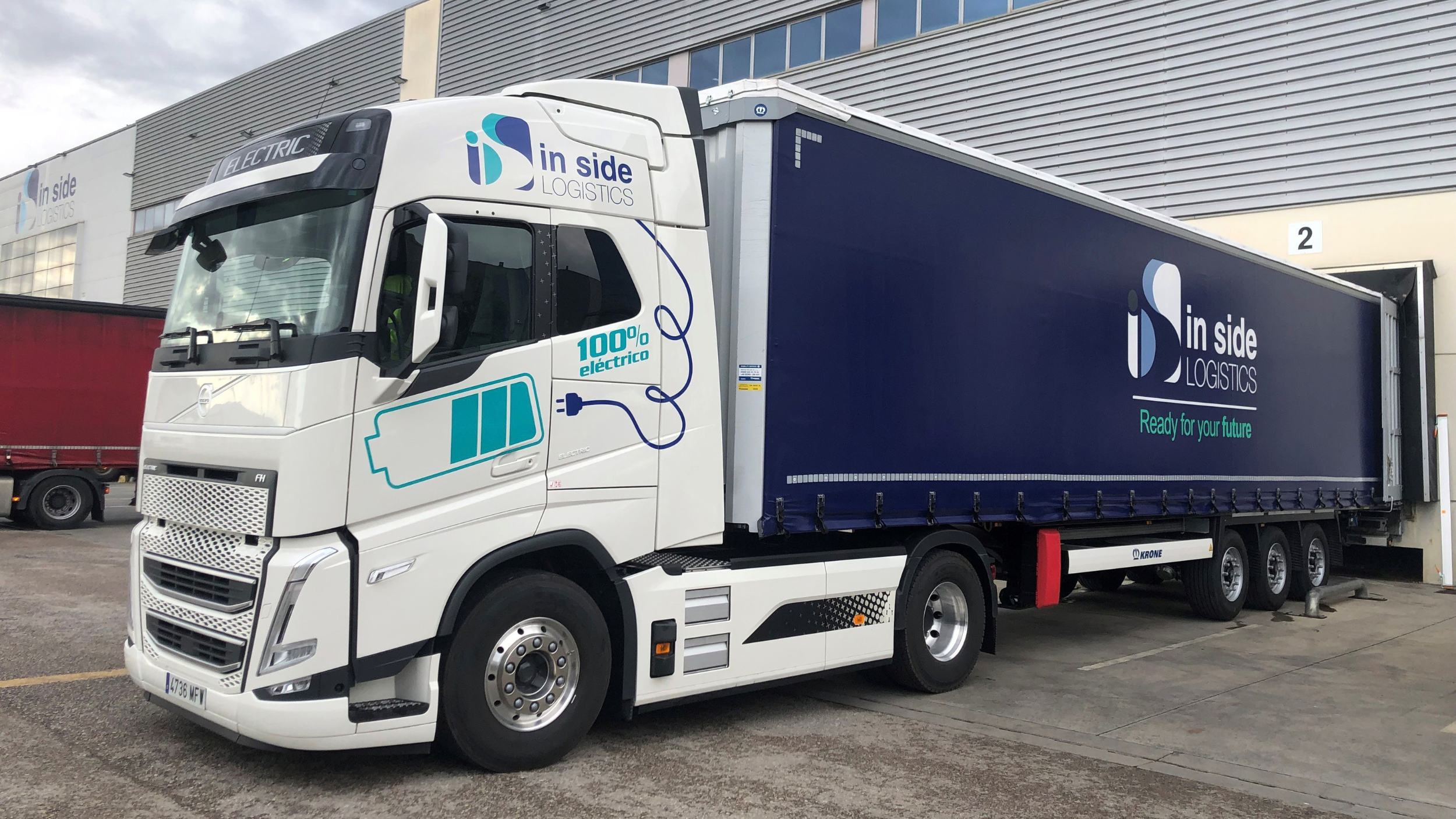
Unfortunately, being ‘green’ is not an advantage in itself. Nobody wants to pay more, and nobody wants restrictions on their range or long recharging times. The market is not going to adapt to electrification; it will have to be the other way round: electric lorries will have to offer better performance and greater cost-effectiveness to gain a firm foothold on the roads. We are expanding our electric fleet and taking steps to improve our range, reduce costs and increase versatility, because one key factor in competing with diesel is driving range, and that is what we are working on – as we are convinced that only through focused attention and effective management can we bring about the changes we seek, and we want to see a shift in the energy model.
> Will the railway be an alternative for certain types of traffic?
It remains to be seen how this will develop. Over the last thirty years, there have been no changes; volumes remain very low and its operational limitations persist – and there are far more of these than in the case of electric lorries. Rail will only become a genuine alternative if it is able to compete on equal terms with diesel lorries. Being environmentally friendly is not an advantage in itself.
> Do you consider that Spanish-owned logistics operators have sufficient capacity to pass on to their customers the actual increase in their energy, labour, financing, insurance, toll and technology costs?
Passing on the increase in costs is necessary to ensure the viability of the service and the ability to continue moving goods. As I mentioned earlier, there is a partnership between the operator and the shipper that enables these issues to be addressed transparently and joint solutions to be sought.
> Cost pressures have become one of the main challenges facing the transport sector. What is currently the cost that is putting the greatest strain on the finances of an operator such as In Side Logistics?
In the transport sector, the costs that put the most pressure on us are always the same: wages, diesel and vehicle tax. What changes is the amount, which continues to rise. As in any other industry, we must adapt and find ways to improve efficiency and make better use of every kilometre travelled.
> From October 2026, the DeCA electronic administrative control document will become mandatory for domestic transport in Spain. Does the digitisation of documentation actually lead to cost savings, or does it simply shift administrative costs from paper to computer systems?
The electronic control document will enable information to flow digitally between the shipper, the operator, the driver and the authorities. This development will facilitate real-time tracking of the physical movement of goods and pave the way for further improvements. I welcome the fact that public authorities are driving this change forward.
> Is there currently too much transport capacity in certain sectors and too little in others? Where are you seeing the greatest imbalance between supply and demand?
In my experience, the greatest pressures arise in transport flows rather than in specific segments. Trade imbalances between regions or countries create areas where supply or demand is concentrated. The market adjusts through prices and by seeking alternative return flows. Managing this balance effectively is one of the key aspects of an operator’s role.
> The shortage of drivers has been cited for years as one of the sector’s major problems. Has the situation really changed, or have we simply learnt to live with the shortage?
The situation has been following a worrying trend for years: there is no generational succession and the age gap is widening. Social priorities have changed, which is a natural and positive development. Spending the whole week away from home takes a toll that we must recognise and reward more effectively. As companies, we need to pay closer attention to this issue and be more creative in finding solutions. It is becoming increasingly clear to me that the future of logistics companies lies in people management, particularly in a sector such as transport, which is so labour-intensive and where staff make a decisive contribution. At In Side Logistics, we offer flexible shift patterns, financial incentives, training and other measures to improve conditions for our professional drivers.
> Do you think that large operators have a structural advantage over small and medium-sized transport firms, or is there still room for small, highly specialised companies?
Compared with other sectors, there is still scope for further consolidation. At the same time, I believe that collaboration between operators of different sizes is growing, as each brings its own value to the supply chain. In a demand environment such as the current one, effective collaboration between hauliers makes it possible to resolve complex situations.
> In Side Logistics works closely with the main port hubs. Is there room for improvement in the relationship between the port, the terminal, the shipping line, the logistics operator and the carrier?
The port sector is highly strategic and complex. Furthermore, it requires very large investments, which have been made but which never seem to be enough given the pace at which the sector is developing. There is still considerable room for improvement, but significant progress has also been made.
> Have shippers changed their procurement strategy as a result of the Red Sea crisis and geopolitical tensions? Are they stockpiling more goods to ensure greater security?
The increase in journey times has made it necessary to increase the stock to ensure supply. At the same time, it has improved procurement management, supported by technologies that enable sales and orders to be updated in real time. This makes it easier to maintain stock levels that are better aligned with requirements. A good logistics partner that assists with these calculations provides significant value to the customer, enabling them to plan their supply more effectively without relying solely on their financial capacity to guarantee supply.
> Are we entering a phase in which companies will be willing to pay more for resilient supply chains, even if they are less efficient from a strictly economic point of view?
As we at In Side Logistics tell our clients: It’s not what you spend, it’s what you save. The operator’s role is to help companies devote more time to joint planning, so that 90 per cent of the operation is as efficient as possible in terms of service and cost, and to be prepared to deal with the remaining 10 per cent, on the assumption that this will be less efficient. Poor planning increases the proportion of less efficient operations and can lead to the logistics budget being exceeded – something no operations manager wants. The greater the control, the greater the ability to adapt and the lesser the impact of unforeseen events.
> The EU has approved the most significant reform of its customs union in decades, involving a future European customs authority and a major European data hub. Will this really simplify matters for businesses, or is there a risk that it will increase technological and administrative complexity?
Efectivamente con la última reforma del CAU se aprueba una gestión de datos a nivel europeo controlado por un organismo de la UE. Esta reforma tiene como fin una unificación de la legislación aduanera. Es una reforma muy ambiciosa que costará que llegue y se implante como todo lo que se trata de unificar a nivel europeo, pero llegará.
The character:
Xabier Azarloza was born in Amorebieta (Biscay) in 1973. He began his professional career at Vasco Catalana de Consignaciones in 1996. In 2004 landed in Valencia to found and launch the In Side Logistics project,headquartered in Ribarroja, from where he has built up a business – with the support Grupo Vasco– with an annual turnover of more than 40 million, and of which he is the chief executive and managing director..
Read the full interview in Transporte XXI: https://www.transportexxi.com/xabier-azarloza/